


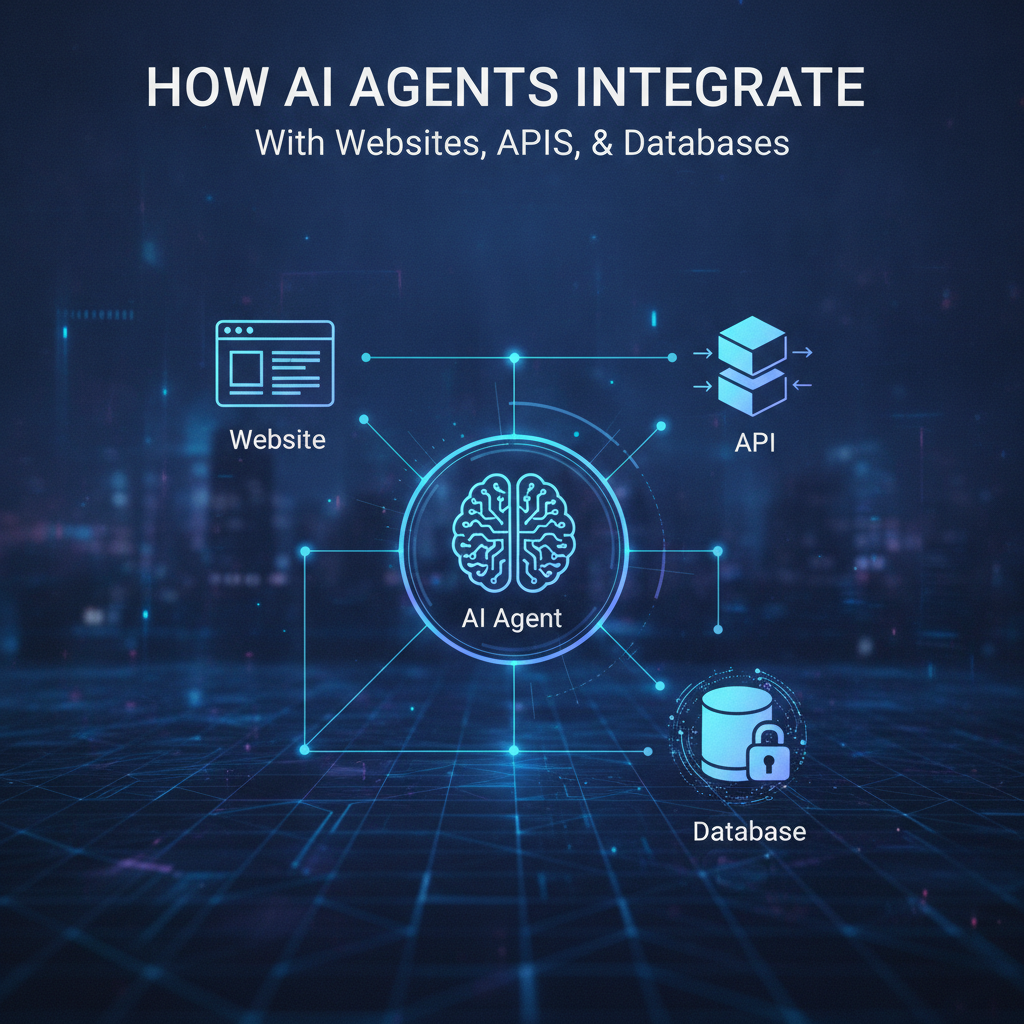
# How AI Agents Integrate with Websites, APIs, and Databases for Seamless Automation
In today’s fast-evolving digital landscape, AI agents are emerging as powerful tools, transforming how businesses operate and interact with the digital world. But what makes these intelligent agents truly revolutionary isn’t just their ability to process information; it’s their capacity to seamlessly integrate with existing digital infrastructure: websites, APIs, and databases. This integration unlocks unprecedented levels of automation, data leverage, and operational efficiency.
Let’s dive into how AI agents connect with these crucial components to create intelligent, autonomous systems.
## AI Agents & Websites: The Digital Navigators
Websites are the primary interfaces for human interaction with online services. For AI agents, interacting with websites involves navigating web pages, extracting information, and even performing actions just like a human user would.
**How they integrate:**
* **Web Scraping & Data Extraction:** AI agents utilize sophisticated web scraping techniques to programmatically browse websites, identify relevant elements (text, images, links, data tables), and extract specific information. This can involve parsing HTML, using CSS selectors, or XPath.
* **UI Automation (Robotic Process Automation – RPA):** Beyond just data extraction, AI agents can mimic human user actions. They can click buttons, fill out forms, log into accounts, upload files, and navigate complex user interfaces to complete tasks that would typically require manual intervention.
* **Natural Language Understanding (NLU):** When interacting with websites that involve chat interfaces or complex textual content, AI agents employ NLU to understand the context, respond appropriately, or summarize information.
**Use Cases:** Competitor price monitoring, lead generation from public directories, automated content aggregation, online form submission, customer service automation through web portals.
## AI Agents & APIs: The Language of Systems
Application Programming Interfaces (APIs) are the backbone of modern interconnected applications, allowing different software systems to communicate and exchange data in a structured, efficient manner. For AI agents, APIs are a direct, programmatic pathway to accessing functionalities and data from various services without needing a user interface.
**How they integrate:**
* **Sending HTTP Requests:** AI agents interact with RESTful APIs by sending standard HTTP requests (GET, POST, PUT, DELETE) to specific API endpoints. These requests carry data or instructions in formats like JSON or XML.
* **Receiving & Parsing Responses:** Upon receiving a response from an API, the AI agent parses the data (often JSON) to extract the required information or confirm the successful execution of an action.
* **Authentication & Authorization:** AI agents handle API authentication (e.g., API keys, OAuth tokens) to ensure secure access to protected resources and services.
**Use Cases:** Fetching real-time stock prices, integrating with CRM systems to update customer records, triggering actions in cloud services (e.g., sending emails via SendGrid, managing tasks in Asana), utilizing third-party AI services (e.g., sentiment analysis, image recognition).
## AI Agents & Databases: The Data Maestros
Databases are repositories of structured information, essential for nearly every application. AI agents often need to read from, write to, or update data within databases to perform their tasks, analyze information, or store results.
**How they integrate:**
* **SQL Queries:** For relational databases (SQL, MySQL, PostgreSQL, Oracle), AI agents execute SQL queries to retrieve specific data, insert new records, update existing entries, or delete outdated information.
* **NoSQL Operations:** With NoSQL databases (MongoDB, Cassandra, Redis), agents use specific drivers and commands to interact with document-oriented, key-value, or graph data structures.
* **Object-Relational Mapping (ORM):** Many AI frameworks and programming languages use ORM libraries (like SQLAlchemy for Python) to abstract database interactions, allowing agents to work with database records as programming objects rather than raw SQL.
* **Data Analysis & Reporting:** Agents can pull data for complex analysis, identify patterns, generate reports, or feed data into machine learning models.
**Use Cases:** Automating inventory management, populating user profiles based on behavior, real-time data analytics, maintaining comprehensive audit trails, personalizing customer experiences by fetching user preferences.
## The Synergistic Power of Integrated AI Agents
The true power of AI agents emerges when they integrate across all three domains. Imagine an AI agent that:
1. **Scrapes a website** for new product reviews (website integration).
2. **Sends this data** to a sentiment analysis API (API integration).
3. **Stores the sentiment scores** and review details in a database (database integration).
4. If negative sentiment is detected, it could then **trigger an action** via another API (e.g., create a support ticket in a CRM system) and **log the action** in the database.
This multi-faceted integration allows for the creation of incredibly sophisticated and autonomous systems that can handle complex workflows, respond dynamically to changes, and provide valuable insights that drive informed decisions.
## Conclusion
The ability of AI agents to seamlessly integrate with websites, APIs, and databases is not just a technical feature; it’s a fundamental shift in how we conceive and deploy automation. By bridging the gap between intelligent algorithms and existing digital infrastructure, AI agents are empowering businesses to unlock new efficiencies, enhance customer experiences, and accelerate innovation. As these integrations become more sophisticated, the potential for intelligent automation to transform every facet of our digital lives is virtually limitless.
Ready to explore how AI agent integrations can revolutionize your operations?
