


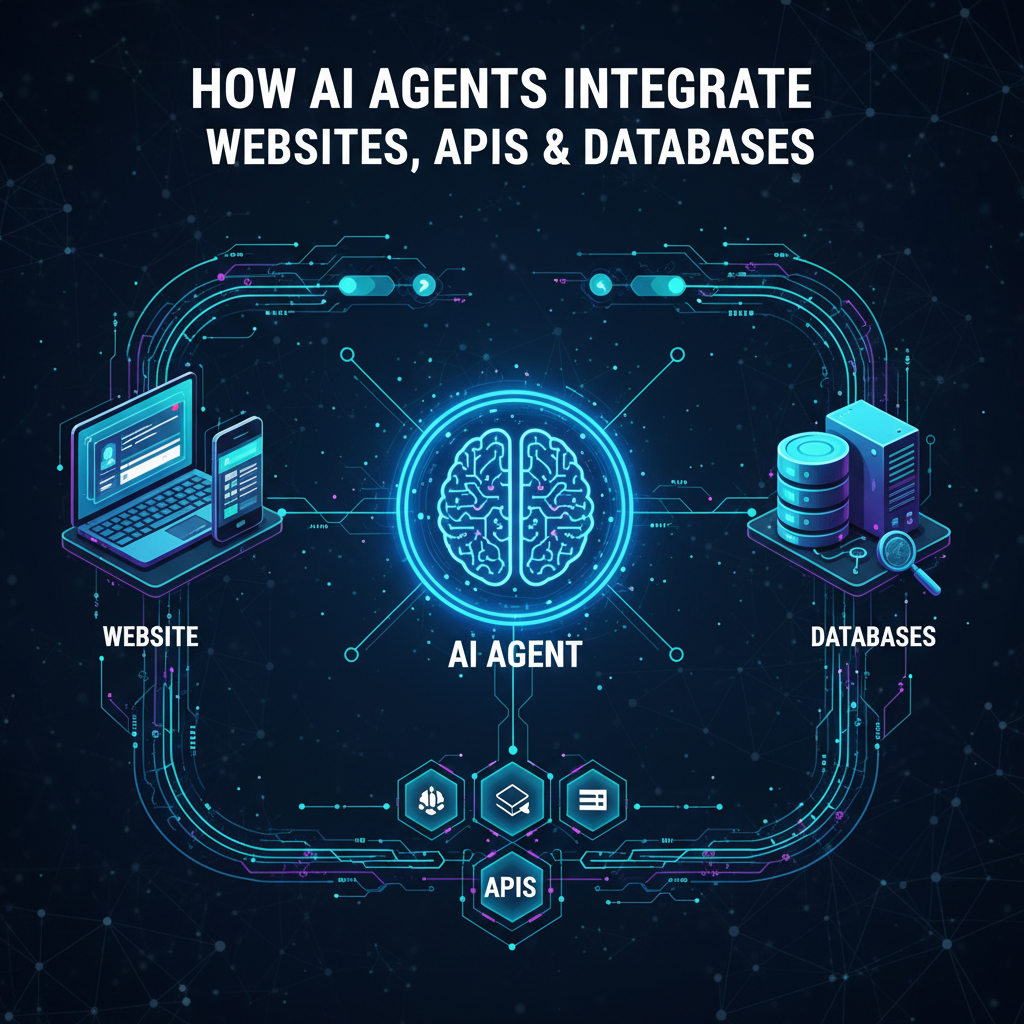
# How AI Agents Integrate with Websites, APIs, and Databases for Unprecedented Automation
In the rapidly evolving landscape of artificial intelligence, AI Agents are emerging as a game-changer. These aren’t just intelligent chatbots; they are autonomous entities designed to perceive their environment, make decisions, and take actions to achieve specific goals. But their true power lies not in their standalone intelligence, but in their ability to seamlessly integrate with the digital world around them: websites, APIs, and databases.
This deep integration transforms AI Agents from mere tools into powerful digital collaborators, capable of automating complex tasks, enhancing user experiences, and unlocking new levels of efficiency for businesses and individuals alike.
## Understanding the AI Agent Advantage
Before diving into integration, let’s briefly define what an AI Agent brings to the table. Unlike traditional software that follows rigid rules, AI Agents often leverage large language models (LLMs) and other AI techniques to understand context, reason, plan, and adapt. They can learn from interactions, pursue long-term objectives, and even break down complex tasks into smaller, manageable steps.
The ability of an AI Agent to interact with external systems is what truly makes it autonomous and powerful.
## Integrating with Websites: Navigating the Digital Front End
Websites are the primary interface for human interaction with the digital world. AI Agents can mimic human browsing behavior to interact with websites, extending their capabilities far beyond simple information retrieval.
**How it works:**
* **Browser Automation:** AI Agents can use headless browsers or browser automation frameworks (like Selenium or Playwright) to load web pages, click buttons, fill out forms, scroll, and extract information – just like a human user.
* **HTML Parsing:** They can analyze the structure of web pages (HTML, CSS) to identify specific elements, extract data, and understand the layout.
* **Contextual Understanding:** Leveraging their LLM capabilities, agents can interpret the content and purpose of a web page, even without explicit instructions for every element.
**Use Cases:**
* **Automated Data Extraction (Web Scraping):** Gathering market research data, competitor pricing, news articles, or public information.
* **Customer Service & Support:** Navigating FAQs, submitting support tickets, or even performing actions on a user’s behalf on a website.
* **Content Generation & Publishing:** Drafting blog posts, product descriptions, or social media updates directly into a CMS.
* **Lead Generation:** Automatically filling out forms on B2B directories or contact pages.
## Integrating with APIs: The Backbone of Digital Communication
APIs (Application Programming Interfaces) are standardized ways for different software applications to communicate with each other. For AI Agents, APIs are a direct, structured, and highly efficient pathway to perform actions and access data without needing to “see” a user interface.
**How it works:**
* **API Calls:** Agents send HTTP requests (GET, POST, PUT, DELETE) to specific API endpoints, providing necessary parameters and authentication.
* **Structured Data Exchange:** APIs typically return data in a structured format like JSON or XML, which agents can easily parse and interpret.
* **Tool Use:** The agent’s reasoning engine determines when and which API “tool” to use based on its current goal and understanding of available services.
**Use Cases:**
* **E-commerce Automation:** Placing orders, updating product listings, managing inventory, processing payments through e-commerce platform APIs.
* **Software Development & Operations:** Interacting with code repositories (GitHub API), project management tools (Jira API), or cloud services (AWS, Google Cloud APIs).
* **Real-time Data Fetching:** Accessing weather data, stock prices, news feeds, or social media analytics.
* **CRM Integration:** Updating customer records, sending personalized emails, creating new leads through CRM APIs.
* **Generative AI Orchestration:** Chaining calls to different AI models (e.g., one for text generation, another for image generation) via their APIs.
## Integrating with Databases: The Source of Truth
Databases are the organized repositories of information that power nearly every digital application. AI Agents can interact directly with databases to store, retrieve, update, and analyze vast amounts of structured data, making them invaluable for data-driven operations.
**How it works:**
* **SQL/NoSQL Queries:** Agents can generate and execute database queries (e.g., SQL for relational databases, or specific commands for NoSQL databases like MongoDB or Cassandra) to interact with data.
* **Database Connectors:** Using standard drivers (e.g., Python’s `sqlite3`, `psycopg2` for PostgreSQL, `mysql-connector`), agents establish connections and manage transactions.
* **Schema Understanding:** Advanced agents can even infer or learn database schemas to formulate effective queries.
**Use Cases:**
* **Personalization:** Retrieving user preferences, purchase history, or behavioral data to tailor experiences (e.g., product recommendations).
* **Business Intelligence & Analytics:** Querying operational databases to generate reports, identify trends, or monitor KPIs.
* **Inventory & Asset Management:** Checking stock levels, updating asset statuses, or managing logistics information.
* **Customer Relationship Management:** Storing and retrieving detailed customer profiles, interaction histories, and service requests.
* **Knowledge Base Management:** Building and maintaining internal knowledge bases by adding new information or correcting existing entries.
## The Synergy of Integration: A Holistic Approach
The true power of AI Agents emerges when these integration methods are combined. An AI Agent might:
1. **Scrape a website** to gather public data.
2. **Process that data** using its internal intelligence.
3. **Update a database** with the new insights.
4. **Trigger an API call** to another service based on the updated data (e.g., send an email notification, create a task in a project management tool).
5. **Optionally, use browser automation** to log into another platform and perform an action.
This multi-modal integration allows AI Agents to orchestrate complex workflows across an entire digital ecosystem, mimicking and even surpassing human capabilities in speed and scale.
## The Future is Integrated: Embracing AI Agent Automation
The seamless integration of AI Agents with websites, APIs, and databases is not just a technological advancement; it’s a paradigm shift in how businesses operate and how we interact with technology. From automating mundane tasks and personalizing user experiences to providing real-time insights and driving strategic decisions, AI Agents are poised to become indispensable.
As AI continues to evolve, the capabilities of these integrated agents will only grow, promising a future of unprecedented automation, efficiency, and innovation.
—
**Ready to explore how AI Agents can transform your business workflows?** Contact us today for a consultation and discover the power of intelligent automation.
