


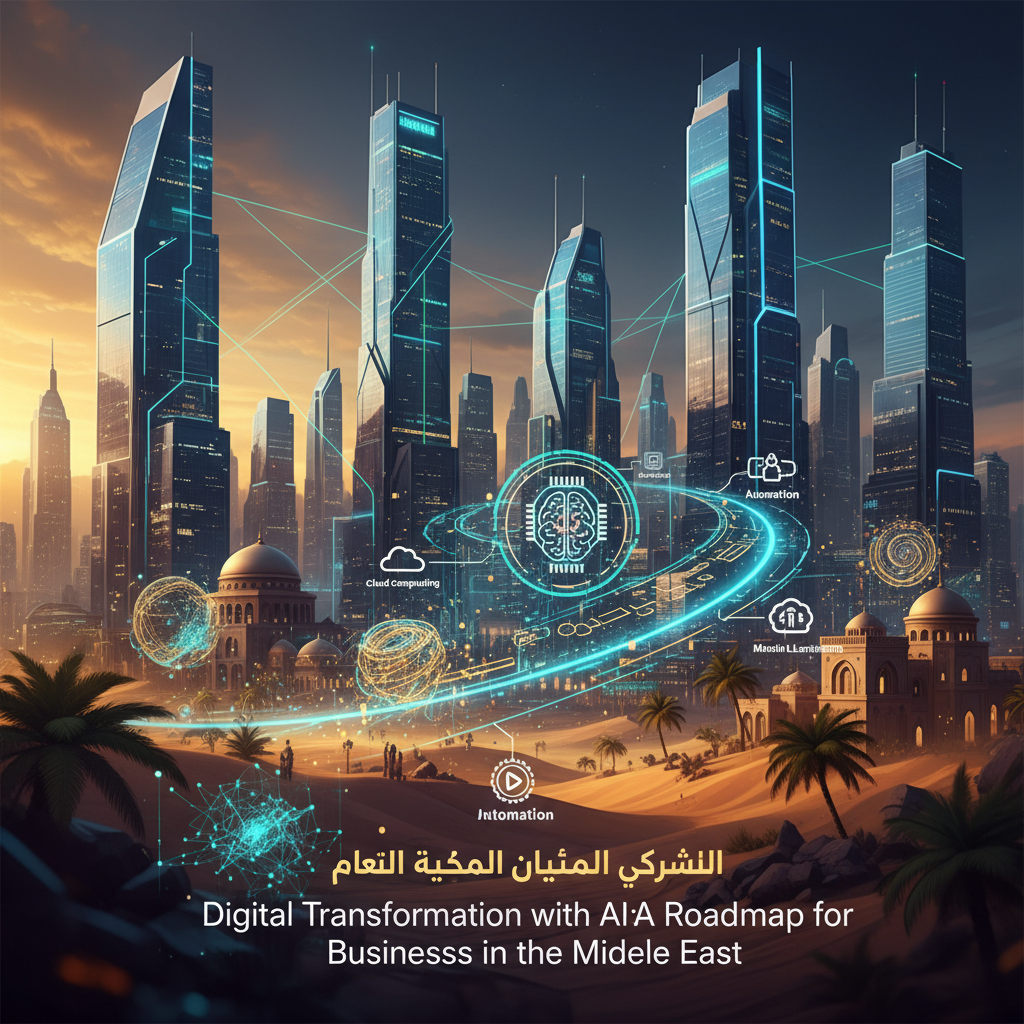
# Digital Transformation with AI: A Roadmap for Businesses in the Middle East
The Middle East is at the cusp of an unprecedented technological revolution. With ambitious national visions driving economic diversification and innovation, businesses across the region are recognizing the imperative for rapid digital transformation. At the heart of this shift lies Artificial Intelligence (AI) – a powerful catalyst poised to reshape industries, enhance efficiencies, and unlock new growth opportunities.
For businesses in the UAE, Saudi Arabia, Qatar, and beyond, embracing AI isn’t just an option; it’s a strategic necessity to remain competitive in a rapidly evolving global landscape. But how does one navigate this complex journey? This article provides a clear roadmap for Middle Eastern businesses to successfully integrate AI into their digital transformation strategies.
## Why AI is Critical for Digital Transformation in the Middle East
The unique economic and social fabric of the Middle East presents both specific challenges and incredible opportunities for AI adoption. Governments are heavily investing in digital infrastructure and smart cities, creating a fertile ground for innovation.
* **Economic Diversification:** AI is a cornerstone for nations like Saudi Arabia (Vision 2030) and the UAE (Centennial 2071) seeking to move beyond oil-based economies towards knowledge-based, diversified sectors.
* **Enhanced Competitiveness:** AI empowers businesses to optimize operations, personalize customer experiences, and make data-driven decisions, giving them a significant edge in local and international markets.
* **Solving Regional Challenges:** From optimizing energy consumption to improving healthcare access and enhancing smart city management, AI offers solutions tailored to the region’s specific needs.
* **Talent Development:** Investing in AI naturally fosters a demand for skilled talent, driving educational and professional development within the region.
## The Roadmap: Key Phases for AI-Powered Digital Transformation
Embarking on an AI-driven digital transformation requires a structured, strategic approach. Here’s a phased roadmap for businesses in the Middle East:
### Phase 1: Assessment & Strategy Formulation
Before diving into technology, understand your current state and future aspirations.
* **Identify Business Imperatives:** Pinpoint critical business challenges or opportunities that AI can address (e.g., customer service bottlenecks, supply chain inefficiencies, market prediction).
* **Define AI Vision & Goals:** Develop a clear vision for how AI will serve your business objectives. What specific outcomes do you want to achieve?
* **Assess Current Capabilities:** Evaluate your existing data infrastructure, technological maturity, and workforce skills. Identify gaps that need to be addressed.
* **Build a Cross-Functional Team:** AI transformation requires collaboration. Assemble a team with representatives from IT, operations, marketing, and senior leadership.
### Phase 2: Data Foundation & Infrastructure Enhancement
AI thrives on data. A robust data strategy is non-negotiable.
* **Data Collection & Governance:** Implement strategies for collecting high-quality, relevant data. Establish strong data governance policies to ensure accuracy, privacy, and security (crucial given evolving regional data regulations).
* **Cloud Adoption:** Leverage cloud platforms (e.g., AWS, Azure, Google Cloud) for scalability, flexibility, and access to advanced AI tools and computing power. Many Middle Eastern governments and enterprises are increasingly adopting local cloud regions.
* **Cybersecurity Fortification:** As data volume grows, so does the attack surface. Invest in state-of-the-art cybersecurity measures to protect sensitive business and customer information.
### Phase 3: Pilot Projects & Capability Building
Start small, learn fast, and build internal expertise.
* **Identify High-Impact Pilot Projects:** Select specific, manageable AI use cases with clear KPIs and a high potential for immediate business value. Examples include AI-powered chatbots for customer support, predictive maintenance in manufacturing, or personalized marketing campaigns.
* **Invest in Talent Development:** Upskill your existing workforce in AI literacy, data science, and machine learning. Partner with local universities or training institutes.
* **Strategic Partnerships:** Consider collaborating with specialized AI consulting firms or technology providers to accelerate your initial efforts and access niche expertise.
### Phase 4: Scaling & Continuous Optimization
Once pilot projects prove successful, it’s time to expand and refine.
* **Integrate AI into Core Operations:** Expand successful pilot projects across relevant departments. Integrate AI models directly into your business processes and systems.
* **Establish MLOps Practices:** Implement Machine Learning Operations (MLOps) to manage the entire AI lifecycle, ensuring continuous monitoring, retraining, and deployment of AI models.
* **Foster an AI-First Culture:** Encourage innovation, experimentation, and data-driven decision-making across the organization. Celebrate successes and learn from failures.
* **Monitor & Adapt:** Regularly review the performance of your AI solutions against business objectives. Be prepared to iterate and adapt your strategies as technology evolves and market conditions change.
## Addressing Unique Challenges in the Middle East
While the opportunities are vast, businesses in the Middle East may face specific hurdles:
* **Talent Gap:** A shortage of highly skilled AI professionals can slow adoption. Investing in local talent development and strategic hiring is key.
* **Data Privacy & Regulations:** Navigating evolving regional data protection laws requires careful attention to compliance.
* **Cultural Adoption:** Ensuring that employees and customers embrace new AI-powered systems requires effective change management and communication.
* **Infrastructure Variability:** While major cities boast world-class infrastructure, ensuring consistent connectivity and digital literacy in all areas remains a consideration.
## The Future is AI-Powered: Embrace the Transformation
Digital transformation with AI is not merely about adopting new technology; it’s about fundamentally rethinking how businesses operate, innovate, and create value. For companies in the Middle East, this journey represents a tremendous opportunity to leapfrog competitors, contribute to national economic visions, and cement their place as leaders in the global digital economy.
By following a structured roadmap, focusing on strategic objectives, and fostering a culture of innovation, Middle Eastern businesses can successfully harness the power of AI to drive unprecedented growth and shape a smarter, more prosperous future.
Are you ready to redefine your business with AI? The time for transformation is now.
